The RAMpocalypse (2026-2030)
Why Your Next RAM Upgrade Might Cost More Than Your Whole PC Used to
Somewhere in 2025, without much fanfare, RAM quietly stopped being the cheap, boring commodity it’s been for your entire life. By 2026, it’s a full-blown crisis with its own nickname (“RAMageddon,” “RAMmageddon,” take your pick), and if you’ve priced out a memory upgrade recently, you already know something’s very wrong. This isn’t a one-quarter blip either. What’s shaping up is a multi-year stretch, realistically running from now through somewhere around 2030, where memory just costs more; plan around it rather than wait it out.
My approach here is simple: understand what’s actually driving this before you spend a dollar reacting to it, and optimize what you already own before you buy your way out of the problem.
What RAM actually is, and why it matters this much
RAM (Random Access Memory) is your computer’s short-term workspace. Your SSD or hard drive stores everything long-term, but it’s too slow to work directly out of. So when you open an app, the CPU pulls the relevant data off storage and loads it into RAM, where it can be read and written almost instantly. More RAM means more programs, browser tabs, and background processes can sit ready to go at once, instead of getting shuffled in and out of storage. Run out of it, and your system starts “swapping” to disk, which is dramatically slower and is the reason a low-memory machine feels like it’s wading through mud.
This is different from long-term storage (SSD/NAND) in one key way: RAM is volatile. Cut the power and everything in it disappears. That’s the tradeoff that makes it fast: nothing extra to maintain, just raw electrical state.
The memory in your PC today is the product of decades of the same basic race: make it faster, make it denser, make it cheaper per gigabyte.
SRAM (Static RAM) came first and is still around today, just not where consumers usually see it. It stores each bit using a small loop of transistors that holds its state as long as power is applied, no refreshing needed. That makes it very fast, but each bit takes up more physical space and more transistors than other memory types, so it’s expensive to make in large quantities. SRAM lives inside your CPU today as cache (L1/L2/L3), the tiny, blazing-fast memory pool sitting right next to the processor cores.
DRAM (Dynamic RAM) is what “RAM” has meant for the average consumer since the 1970s. Instead of a transistor loop, each bit is stored as a charge on a tiny capacitor, which is far more compact and cheap to manufacture at scale, but that charge leaks over time and has to be refreshed thousands of times a second. This tradeoff (slower and more complex than SRAM, but vastly cheaper per gigabyte) is exactly why DRAM became the standard for main system memory, while SRAM stayed confined to small, expensive caches. DDR (Double Data Rate) SDRAM, the specific flavor most people mean when they say “RAM,” has gone through generations (DDR, DDR2, DDR3, DDR4, DDR5), roughly doubling bandwidth each jump while shrinking process nodes to pack in more capacity.
LPCAMM2 is the newest development, and it’s a genuinely different idea rather than just another DDR generation. For years, laptop manufacturers wanting the speed and power efficiency of LPDDR memory had to solder it directly to the motherboard, since the old SO-DIMM slot design couldn’t handle the signal integrity demands of higher speeds. Soldered memory meant zero upgradeability: whatever RAM configuration you bought was permanent. LPCAMM2 (Low Power Compression Attached Memory Module 2) fixes that by using a flat, compression-mounted connector instead of a socket, which handles higher speeds without the signal loss problem while still being removable. It runs LPDDR5X chips at up to roughly 8500+ MT/s, taking up to 60% less board space and using less power than an equivalent SO-DIMM setup. Lenovo, Framework, HP, and Asus have all started shipping it in 2026, and it’s being pitched by repair advocates as a real correction to years of forced-obsolescence laptop design. The same connector idea is starting to creep into desktops too: MSI and Asus have shown ATX motherboard prototypes with CAMM2 slots, aimed less at thinness and more at clearing tall CPU coolers and shortening trace lengths, so this isn’t strictly a laptop story anymore.
So, at the exact moment memory just got a genuinely exciting modular comeback, it also became one of the most expensive components in the whole PC. Bad timing all around.
The scale: this isn’t a normal price bump
DRAM contract prices (the wholesale prices manufacturers charge) jumped an estimated 90 to 95% quarter over quarter in Q1 2026 alone, then kept climbing another 58 to 63% in Q2. Consumer RAM prices specifically inflated by up to 110% in that same window, with SSDs jumping even harder at 147%. Year over year, some DRAM pricing is up around 172%.
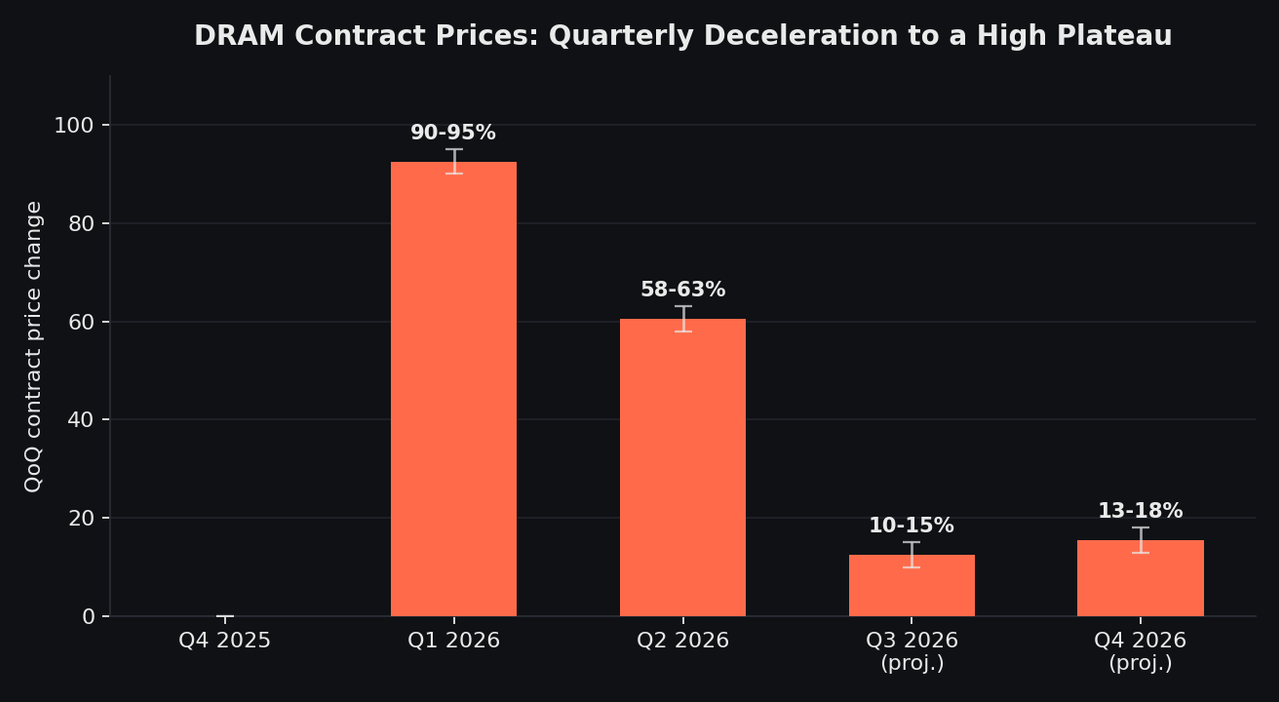
DRAM contract price quarter-over-quarter change
To put that in real terms: a 32GB DDR4 kit that cost $60 to $90 in October 2025 was going for $150 to $180 by January 2026. DDR5 has moved even harder: a 32GB DDR5 kit that ran $100 to $200 in October 2025 was starting around $350 by mid-2026, if it was even in stock. Some analysts floated the idea of $500 32GB DDR5 modules becoming normal in 2026.
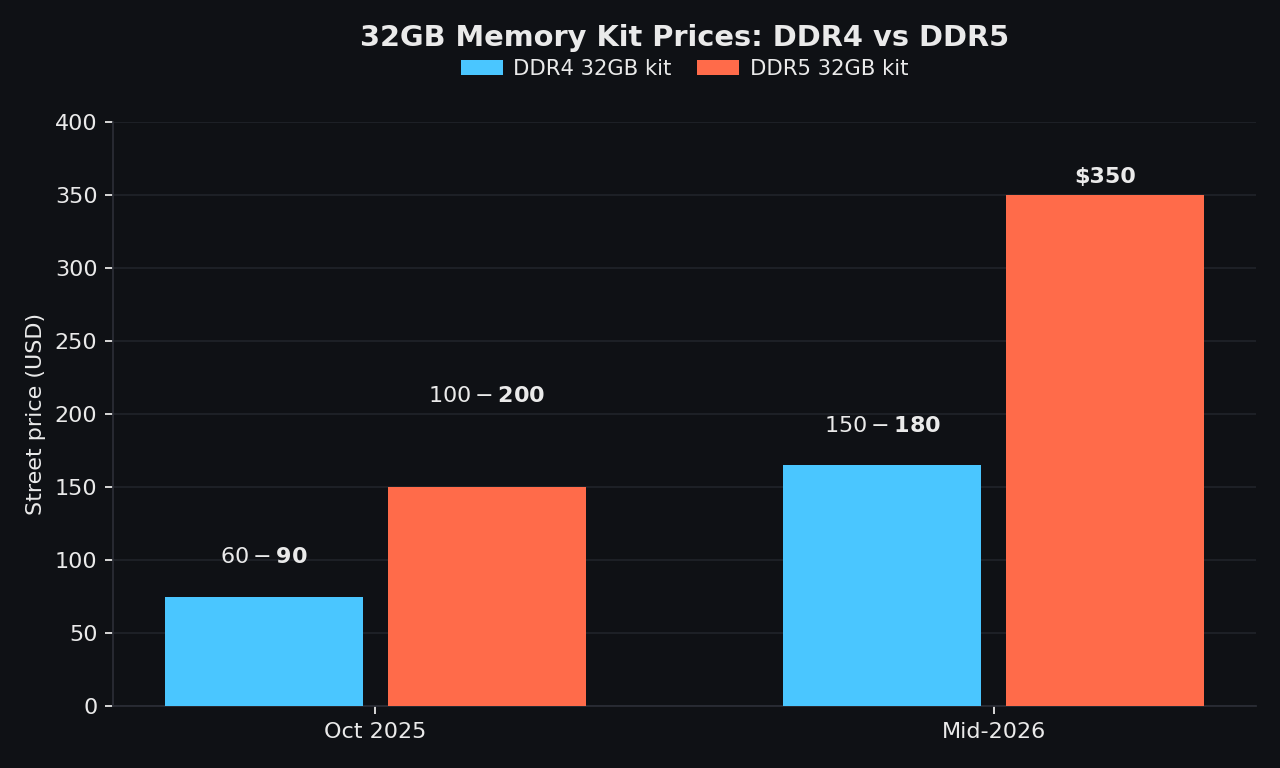
32GB memory kit street prices, DDR4 vs DDR5, October 2025 vs mid-2026
This is hitting more than DIY PC builders. Sony, Microsoft, Nintendo, MSI, and Asus have all raised gaming hardware prices this year, and Valve’s new Steam Machine launched $300 to $350 above its originally targeted price specifically because of memory costs. Apple quietly pulled the 32GB and 64GB Mac mini configs and the 256GB Mac Studio from its store because they couldn’t reliably source the memory. Dell, HP, Lenovo, and Acer have all warned of 15 to 20% PC price increases, and HP says memory now eats up roughly 35% of a PC’s bill of materials, up from 15 to 18% before this started.
What’s actually causing it
Memory shortages (2017 to 2018, 2021) were cyclical. Factories under-invested, demand spiked, prices rose, manufacturers ramped up production, everything normalized. Annoying, but temporary.
This one is structural, and there are a few things stacked on top of each other:
- AI data centers are eating the world’s DRAM supply. Samsung, SK Hynix, and Micron control over 95% of global DRAM production, and all three are deliberately shifting fab capacity away from the RAM in your laptop and toward High Bandwidth Memory (HBM), the specialized, stacked memory that feeds AI accelerators in data centers. HBM ate up 23% of global DRAM wafer production in 2026, up from just 8% in 2024.
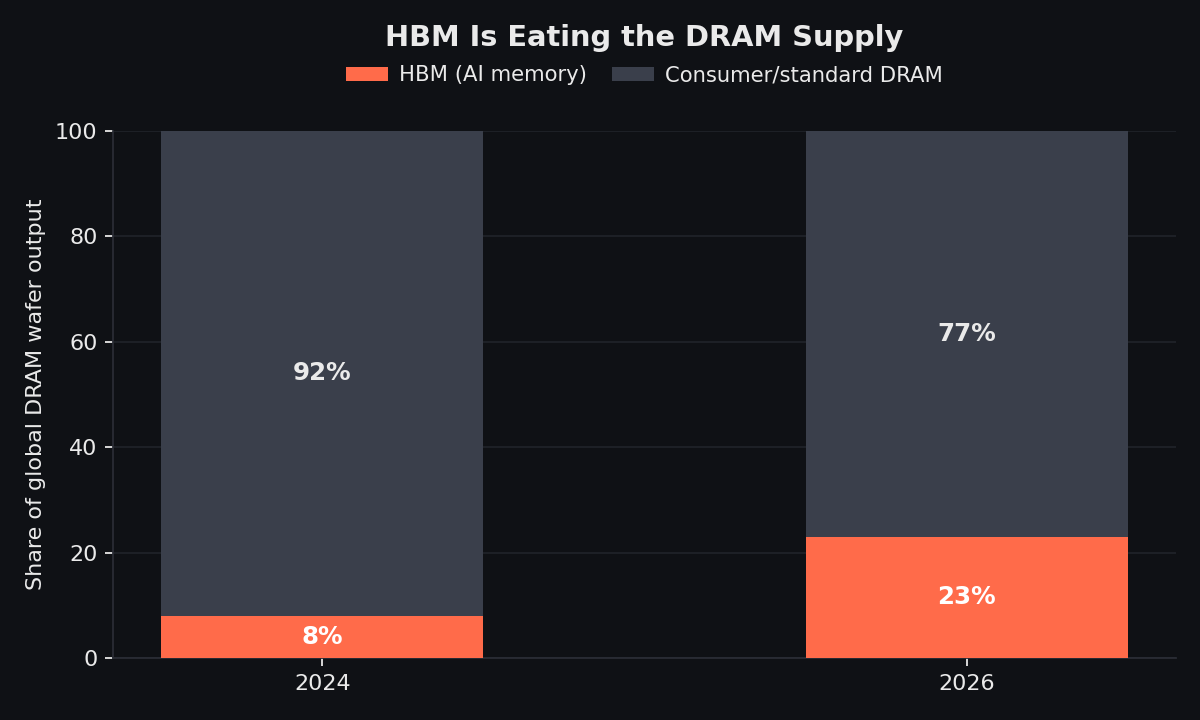
HBM share of global DRAM wafer output, 2024 vs 2026
- HBM is simply more profitable per wafer. A fab can turn the same silicon into either consumer DDR5 or AI-grade HBM, and HBM commands a much higher margin. Given a choice, manufacturers pick the higher-margin product every time, so consumer memory production gets squeezed even without any actual shortage of raw materials.
- Datacenter buyers lock in supply years ahead. Companies like Microsoft, Google, and Meta sign long-term contracts at premium prices to guarantee their AI buildouts get memory first. Fabs serve those contracts before anything reaches retail shelves, so what’s left over for consumers is the remaining retail supply, and in 2026 that remaining allocation is thin.
- NAND flash (SSD storage) is caught in the same squeeze. It’s not just RAM. NAND flash contract prices have also spiked sharply as AI storage demand competes for the same manufacturing capacity, which is why SSD prices have jumped even harder than RAM in some quarters.
- OEMs are stockpiling and panic-buying, which makes it worse. When PC and phone makers see prices about to jump further, the rational move is to buy as much memory as possible right now before it gets more expensive, which pulls even more supply out of the market and accelerates the price climb.
- New capacity takes years, not months, to come online. Building a new fab or converting existing lines back toward consumer memory is a multi-year investment. Even if a manufacturer decided today to prioritize DDR5 production, meaningful new supply wouldn’t show up for years, which is exactly why this shortage doesn’t behave like the shorter cyclical ones from 2017 or 2021.
The bad news: there’s no quick fix on the horizon. Micron’s new capacity additions aren’t expected to ship meaningful volume until mid-2027 at the earliest, and analyst consensus points to no real relief within 2026, with credible normalization estimates stretching into 2028 to 2030. Some analysts think this pricing environment isn’t a spike at all, but a permanent feature of the AI buildout era, since current AI demand forecasts for HBM show no sign of slowing.
The timeline: what 2026 to 2030 probably looks like
Nobody has a crystal ball here, but the pattern analysts keep pointing to breaks down roughly like this:
- 2026 (now): Peak pain, though not uniformly. Q1 and Q2 saw the historic, near-doubling QoQ jumps, but Q3 and Q4 momentum is tracking closer to +13-18% QoQ. That’s a real deceleration from the uncontrolled early-year spike, but don’t mistake it for relief: prices are leveling off onto a brutally high plateau, not coming back down. Contract prices are still up double digits to triple digits year over year, OEMs are still cutting specs or raising prices, and some products (Mac mini configs, certain server RDIMMs) are simply going in and out of stock. This is the pricing environment you’re buying into right now, and current data suggests it isn’t the low point.
- 2027: The first real supply response. Micron’s new capacity additions are expected to start shipping meaningful volume around mid-2027. That doesn’t mean prices drop back to 2025 levels, but it’s the point where the curve should stop climbing and start leveling off.
- 2028: More new fab capacity comes online industry-wide, including facilities explicitly built to add DRAM/NAND supply. This is roughly where the more optimistic forecasts put the start of genuine normalization, though “normal” here may still mean higher than 2025 prices.
- 2029 to 2030: The more conservative estimates (including some from major memory makers themselves) put full recovery here rather than earlier. Some analysts think elevated pricing might not fully unwind at all, since AI datacenter demand for HBM isn’t going away and keeps competing for the same fab capacity.
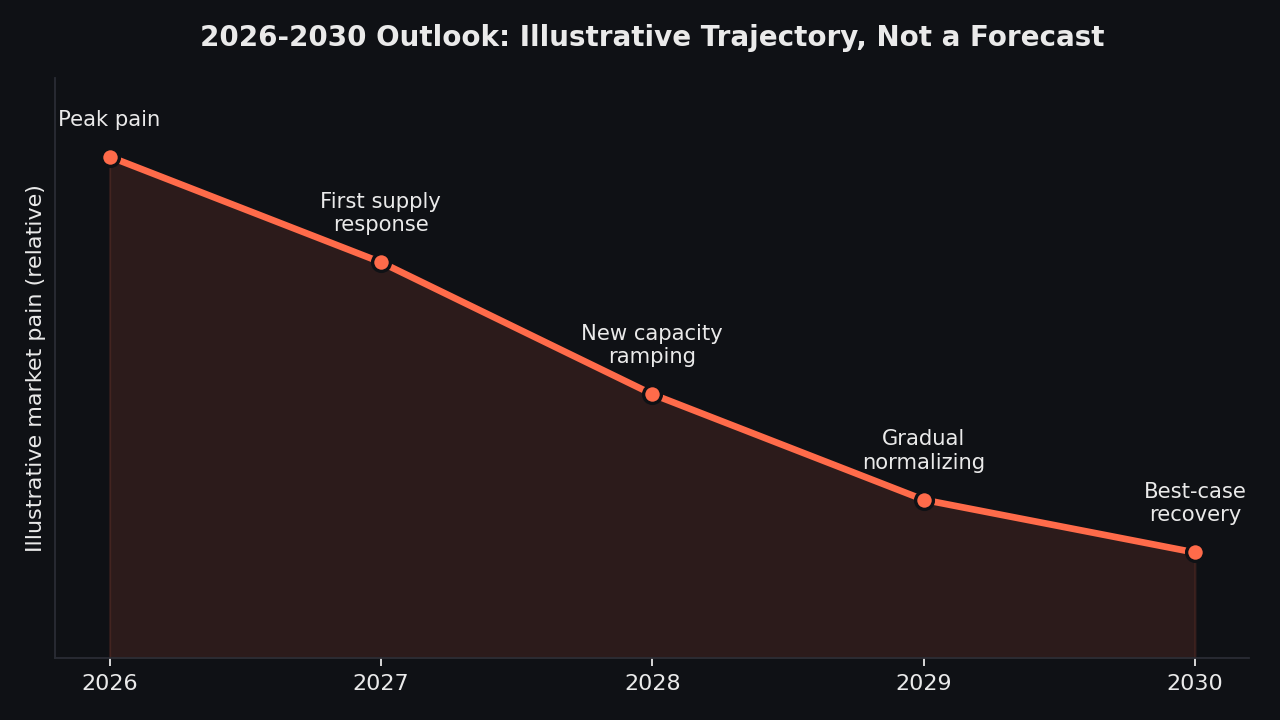
Illustrative 2026-2030 market outlook
The honest takeaway: treat 2026 as the worst of it, 2027 as “still bad but improving,” and 2028 to 2030 as the window where things gradually start looking normal again, if they do at all. Anyone telling you memory prices snap back next quarter is guessing.
The new RAM order: why $80 kits probably aren’t coming back
Here’s the part worth sitting with: even the optimistic 2028 to 2030 recovery scenarios above are talking about prices leveling off, not falling back to where they started. A 32GB DDR4 kit that cost $60 to $90 in October 2025 is not on a path back to that range. What “recovery” actually means in most of these forecasts is the rate of increase slowing to something closer to normal, on top of a permanently higher base price. The old baseline isn’t the destination. It’s the thing this market moved away from.
That’s a different kind of shortage than the ones DDR has weathered before. In 2017 to 2018 and 2021, once new fab capacity came online, memory prices genuinely fell back toward where they’d been, because the demand spike itself was temporary (crypto mining, pandemic device buying) and faded once it passed. This time, the demand pulling capacity away from consumer DRAM is AI datacenter buildout, and nothing in the current forecasts has that slowing down on any near-term timeline. Structurally, that means fabs have very little incentive to ever fully rebalance back toward cheap consumer DRAM, since HBM keeps paying better. The shortage may ease. The underlying reason for the higher price floor doesn’t go away.
What this “new normal” is likely to actually look like, based on current trajectories:
- A permanently higher price floor. Expect the resting price of mainstream DDR5 to settle well above pre-2025 levels once things stabilize, not just during the shortage but as the new baseline going forward.
- Memory becomes a bigger, more visible line item. HP’s estimate that memory now eats up roughly 35% of a PC’s bill of materials, up from 15 to 18% before this started, is a preview of the new math OEMs are building around, not a temporary spike they’re expected to design past.
- Base configurations shrink, and upgrades cost more. Expect entry-level laptops, phones, and consoles to ship with less RAM by default, while the “buy more memory” upsell becomes proportionally more expensive than it used to be. Manufacturers manage the higher cost by pushing more people toward paying for the upgrade rather than absorbing it into the base price.
- Modularity becomes a bigger selling point, not a cost-saving footnote. LPCAMM2 and desktop CAMM2 don’t fix the pricing problem, but they change the calculus: paying a premium for memory now stings less if you can add to it later instead of buying a whole new device because the soldered configuration is fixed forever.
- Buying decisions get more permanent. In a world where a $60 to $90 RAM top-up isn’t coming back, the amount of memory you buy today matters more, since “I’ll just add more later” is a much more expensive fallback than it used to be, even accounting for LPCAMM2’s upgrade path.
None of this means the market stays frozen at 2026’s worst prices forever. It means the reference point resets. Budgeting for hardware in 2027 and beyond probably means treating today’s inflated DRAM pricing less as an anomaly to wait out and more as the new floor to plan around.
The PSA part: what to actually do about it
If you were holding off on a RAM upgrade hoping for a sale, that plan is dead. But you’re not powerless.
Stop thinking “upgrade,” start thinking “optimize.”
Before you spend hundreds on more RAM, squeeze what you already have:
- Kill background bloat (startup apps, browser extensions, telemetry processes). Task Manager or Activity Monitor is your friend.
- If you’re on Windows, check your pagefile/swap settings. A well-configured swap on a fast SSD can meaningfully cushion RAM pressure.
- Close browser tabs like they’re costing you money, because right now they kind of are. Chrome alone can eat gigabytes doing nothing useful.
- On Linux, tools like zram (compressed RAM-based swap) can buy you real headroom without touching hardware.
- If you’re a developer, check what’s actually resident vs. what’s just allocated. Plenty of dev tooling (looking at you, Electron apps and language servers) reserves way more than it needs.
If you do need to buy, buy smart.
- Buy memory inside a finished product (a prebuilt PC, a laptop) rather than as a bare kit when possible. OEM bulk contracts sometimes insulate you from the worst of the spot-price spikes.
- Treat Black Friday and Prime Day as your realistic discount windows this year, but temper expectations: you’re getting a discount off 2026’s inflated baseline, not 2025 prices.
- If your motherboard supports DDR4 and DDR5, get pricing on both before assuming DDR5 is the “future-proof” choice. Right now, future-proof and reasonably priced aren’t the same thing.
- Don’t panic-buy at the first price spike headline. Prices are moving in stair-steps, not smoothly, so timing still matters even in a bad market.
Play the long game.
This shortage is fundamentally tied to how much compute the world wants to throw at AI training and inference. The realistic relief valves are new fab capacity (which arrives on the 2027 to 2028 timeline above), a slowdown in AI datacenter spending, or a shift in how memory manufacturers allocate wafers, and none of those move on a consumer’s upgrade timeline. For most people, the move through at least 2027 is to extend the life of what you have and make targeted rather than wholesale upgrades. By 2028 to 2030, revisit the market: that’s roughly when new capacity and any AI demand cooling would start actually showing up in retail prices.
If there’s a silver lining, it’s that this is a good excuse to actually learn what’s eating your memory instead of just throwing more at the problem, which might be the most useful habit to come out of the whole RAMpocalypse.
References
Market Analysis & Pricing
- Tom’s Hardware, “RAM price tracking 2026“
- Wccftech, “RAM Shortage 2026 Explained: Why AI Is Causing a DDR5 Crisis & When It Ends“
- Unibetter, “RAM Memory Shortage 2026 Guide: Price Trend and Market Outlook Analysis“
- ipc2u, “RAM Prices 2026: Why DDR5 is Expensive & IT Strategies“
- DatacenterDisk Research, “The 2026 Memory Chip Shortage: Why Server RAM Prices Have Doubled and When It Ends“
- Modemguides, “When Will RAM Prices Go Down? The 2026 Shortage, Explained“
- Insight, “2026 RAM Shortage Solutions: Survive the Memory Crisis“
- TechRadar, Memory coverage archive
Memory Technology
- RankedRAM, “CAMM2 and LPCAMM2 memory explained“
- Aioapex, “LPCAMM2: upgradeable laptop RAM returns“
- rampricesusa, “LPCAMM2 & CAMM2 Laptop Upgrade Guide“
Consumer Hardware & Industry Impact
- Tech Insider, “RAM Shortage 2026: AI Chips Hit 5 Gaming Platforms’ Prices“
Primary Manufacturer Sources
- Samsung Semiconductor, LPCAMM2 module overview
- Micron, LPCAMM2 product page
- Innodisk, “LPDDR5X CAMM2 / LPCAMM2“
- Framework, “Framework Laptop 13 Pro Deep Dive: LPCAMM2“
Repair & Upgradeability
- iFixit, “LPCAMM2 Is Finally Here, and It’s a Big Deal“
- XDA Developers, “The next generation of laptops will ship with CAMM2 memory“
- foro3d, “LPCAMM2 Memory: the end of soldered memory in laptops“
Note: Price percentages, wafer-share estimates, and recovery timelines are synthesized from the analyst reports and industry coverage listed above (including TrendForce, IDC, and Kearney where cited within them). Forecasts represent informed projections rather than guaranteed outcomes, and specific figures should be interpreted as directional rather than exact.